


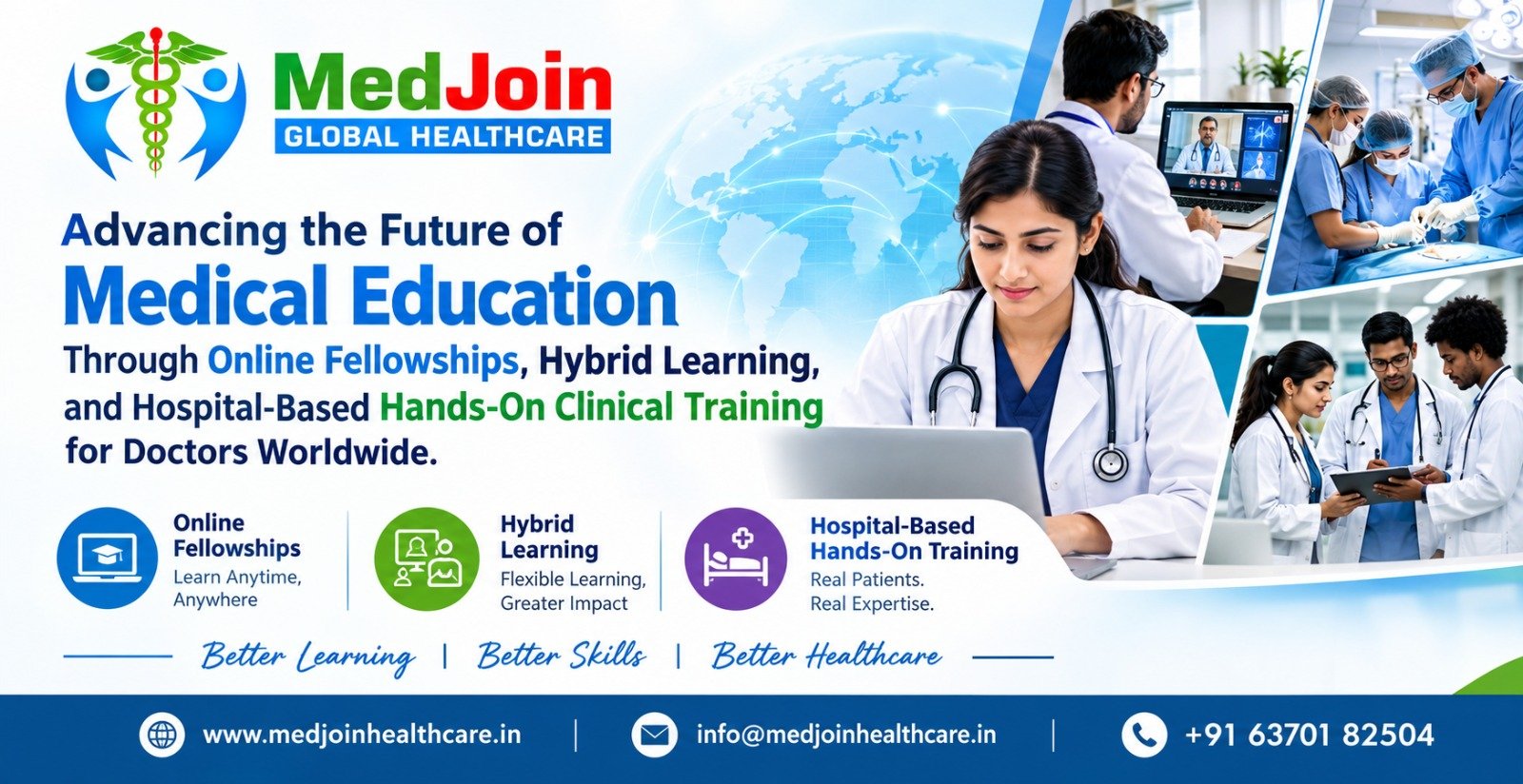
The organisation is advancing flexible medical education through online fellowship programmes, hybrid learning pathways and hospital-based clinical training opportunities for doctors worldwide.
Advancing Medical Education Through Flexible Learning Pathways
MedJoin Global Healthcare is contributing to the evolving landscape of medical education by offering fellowship-oriented learning opportunities designed to help doctors strengthen their clinical knowledge, explore specialised medical disciplines and pursue continuing professional development through flexible educational formats.
Through online fellowship programmes, hybrid learning pathways and hospital-based clinical fellowship training, the organisation aims to make supplementary medical education more accessible to doctors at different stages of their professional journeys.
As healthcare systems respond to medical advancements, changing patient needs, emerging diagnostic technologies and increasingly specialised clinical practices, continuous learning has become an important part of professional development. Medical professionals must regularly update their knowledge, refine their clinical reasoning and remain informed about evolving approaches to patient care.
MedJoin Global Healthcare seeks to address these educational needs through learning pathways that bring together structured academic content, digital learning resources, expert interactions, clinical discussions and hospital-based exposure, where available.
Recognising that doctors have different professional commitments and learning objectives, the organisation offers multiple educational formats. Online programmes provide flexibility for professionals continuing their clinical practice, while hybrid pathways combine digital learning with in-person educational exposure. Hospital-based programmes offer eligible learners opportunities to engage with clinical environments through activities permitted by participating institutions.
Together, these formats reflect an approach to postgraduate learning that emphasises accessibility, flexibility and clinical relevance.
Reimagining Medical Education for a Changing Healthcare Industry
The healthcare industry is undergoing continuous transformation. Advances in medical technology, digital health, artificial intelligence, diagnostics, treatment protocols and specialised clinical services are changing how healthcare professionals learn and deliver care.
At the same time, doctors must balance demanding professional responsibilities with the need to update their knowledge and acquire additional competencies.
Traditional educational pathways remain essential, but working professionals may also benefit from supplementary learning opportunities that accommodate their schedules and career objectives. Digital education, interactive academic sessions, structured assessments and supervised clinical exposure can provide additional avenues for professional development.
MedJoin Global Healthcare is developing its educational offerings around this changing landscape. By bringing together online instruction, hybrid learning and hospital-based training opportunities, the organisation aims to provide doctors with different routes to explore specialised medical subjects and strengthen their professional capabilities.
Its approach is built around a central principle: medical education should support lifelong learning while recognising the practical realities of modern clinical practice.
For doctors who cannot easily relocate, online learning may offer a convenient starting point. Hybrid pathways may suit professionals seeking a combination of digital instruction and in-person exposure, while eligible learners looking for a more immersive educational experience may consider hospital-based training.
The availability, structure and scope of each pathway depend on the selected programme and the arrangements confirmed with the relevant institution.
Online Fellowship Programmes: Expanding Access to Medical Learning
Online education has become an increasingly important component of professional learning. It allows doctors to access educational resources without necessarily leaving their workplaces, relocating to another city or interrupting their professional responsibilities.
MedJoin Global Healthcare offers online fellowship learning pathways for doctors interested in expanding their knowledge across selected medical specialities and clinical disciplines. These programmes are intended to provide structured educational content through digital platforms, with resources and learning activities determined by the relevant curriculum.
Depending on the programme, learners may have access to recorded lectures, educational modules, study materials, assessments, live academic sessions and clinical case discussions.
For working doctors managing outpatient consultations, hospital duties, emergency responsibilities or private practice, this flexibility can be particularly valuable. Online learning allows educational activities to be organised around professional commitments and personal schedules.
Key features of online fellowship learning may include:
- Flexible learning: Study around clinical duties and professional commitments.
- Digital accessibility: Access programme materials through available online learning platforms.
- Structured education: Follow organised modules relevant to the selected speciality.
- Knowledge reinforcement: Revisit recorded lectures and study materials where available.
- Professional development: Explore specialised clinical subjects aligned with individual learning goals.
- Geographical convenience: Participate in academic sessions without relocating solely for routine online instruction.
- Continuing engagement: Reinforce learning through assessments, discussions and academic interactions where offered.
Online fellowship education may be suitable for doctors seeking to strengthen their theoretical understanding, explore a new area of interest or pursue supplementary learning alongside existing professional responsibilities.
However, the educational format must match the learner’s objectives. Online study can support knowledge acquisition and clinical reasoning, but it should not be treated as equivalent to supervised, hands-on procedural training. Practical competencies requiring direct observation, demonstration or supervised performance must be developed through appropriate clinical education and assessment.
Understanding these distinctions is essential when selecting a medical education pathway.
Hybrid Fellowship Programmes: Connecting Digital Learning With Clinical Exposure
Hybrid education combines online academic learning with an in-person component. In medical education, this approach can help connect conceptual understanding with exposure to real healthcare environments.
MedJoin Global Healthcare offers hybrid fellowship pathways intended for doctors who wish to combine digital education with clinical exposure where it forms part of the selected programme.
Depending on the programme, the learning journey may include online modules, recorded lectures, live sessions, academic assessments, case-based discussions and a defined period of clinical observership or supervised educational exposure at a participating hospital.
The duration and nature of the clinical component vary according to the programme and the arrangements confirmed with the learner. Some pathways may feature an extended online learning phase followed by a shorter in-person component, while others may follow different schedules.
The academic and clinical elements serve complementary purposes. Online study provides an opportunity to review relevant concepts and prepare for clinical discussions. In-person exposure can help learners observe clinical workflows, understand multidisciplinary collaboration and connect theoretical knowledge with practical healthcare settings.
Potential benefits of hybrid learning include:
- A balance between flexibility and exposure: Complete academic learning online while planning the clinical component according to confirmed arrangements.
- Preparation for clinical learning: Build foundational knowledge before participating in hospital-based educational activities.
- Professional interaction: Observe collaboration among doctors, nurses, allied health professionals and other members of healthcare teams, where permitted.
- Contextual understanding: Develop familiarity with patient pathways, documentation practices, diagnostic processes and multidisciplinary care.
- Adaptability: Pursue supplementary education without necessarily committing to a full-time, year-long in-person programme.
The value of a hybrid fellowship depends on its curriculum, academic support, clinical placement arrangements, supervision and the learner’s active participation.
Doctors should therefore review the specific clinical activities, programme duration, eligibility criteria, assessment requirements and supervision arrangements before enrolling.
For MedJoin Global Healthcare, hybrid learning represents an opportunity to connect digital medical education with practical exposure while accommodating the professional realities of practising doctors.
Hospital-Based Hands-On Clinical Fellowship Training: Learning Within Healthcare Environments
Hospital-based clinical education remains an important component of developing practical medical competencies. Healthcare environments provide opportunities to observe patient pathways, understand clinical decision-making, study diagnostic approaches and learn how multidisciplinary teams coordinate care.
MedJoin Global Healthcare offers hospital-based clinical fellowship training opportunities for eligible doctors through relevant programme and institutional arrangements. These pathways are intended to provide an educational environment in which learners can engage with clinical practice through activities appropriate to their qualifications, learning objectives and authorised level of participation.
Depending on the programme and participating institution, educational activities may include clinical observation, case discussions, exposure to departmental workflows, demonstrations, academic interactions and supervised practical learning where specifically authorised and available.
The nature of participation varies according to the speciality, institutional policies, professional registration, learner eligibility, patient-safety requirements and applicable regulations.
Importantly, participation in a clinical fellowship does not automatically authorise a doctor to independently examine, diagnose, prescribe, perform procedures or treat patients. Such activities require the appropriate qualifications, registration, supervision, institutional authorisation and legal permissions.
This distinction is fundamental to responsible medical education. Effective clinical learning must protect patients while providing learners with appropriate educational opportunities.
Why Hospital-Based Clinical Learning Matters
Understanding real-world clinical workflows
Hospital environments help doctors observe how patients move through consultation, investigation, diagnosis, treatment planning, follow-up and multidisciplinary care.
Developing clinical reasoning
Case-based discussions can help learners explore differential diagnoses, interpret clinical information, evaluate management options and understand the reasoning behind medical decisions.
Learning from clinical teams
Interaction with experienced professionals, where arranged, can expose learners to different approaches to clinical problem-solving, communication, documentation and collaborative care.
Connecting theory with practice
Clinical exposure helps learners contextualise academic concepts and understand how medical knowledge is applied within the responsibilities and limitations of real healthcare settings.
Appreciating patient safety and professional ethics
Clinical education can provide opportunities to understand confidentiality, informed consent, infection prevention, appropriate documentation, professional boundaries and institutional protocols.
Building a foundation for further learning
Hospital exposure may help doctors identify areas requiring additional instruction, supervised practice or formal competency assessment.
MedJoin Global Healthcare’s hospital-based training pathways are intended to support educational development through structured learning opportunities rather than promise automatic clinical privileges or independent practice rights.
Doctors are encouraged to evaluate programmes according to the educational activities offered, supervision available, suitability of the hospital environment and relevance of the training to their individual objectives.
Supporting Doctors Across the Globe
Medical professionals work in diverse healthcare systems, each with different clinical demands, professional regulations, educational resources and career opportunities. An educational format that suits one doctor may not be practical for another.
A doctor in full-time hospital practice may prefer online study. An international medical graduate may wish to explore additional educational exposure in India. A physician interested in a subspecialty may benefit from structured academic modules, while a doctor seeking practical exposure may prioritise an appropriate clinical placement.
MedJoin Global Healthcare aims to accommodate these varied learning needs through its range of programme formats.
Digital learning can make academic participation more accessible to doctors living outside major educational centres. Hybrid options may suit professionals able to arrange a limited period of in-person training, while hospital-based programmes may appeal to eligible learners who can commit to a suitable period of clinical education.
For international participants, programme planning may involve additional considerations, including travel arrangements, immigration and visa requirements, professional eligibility, hospital permissions, insurance, accommodation and the scope of permitted clinical activities.
These requirements must be assessed individually and in accordance with the rules of the relevant authorities and institutions. Participation in an educational programme does not automatically confer medical registration, specialist recognition, immigration permission or the right to practise medicine in another country.
By recognising these practical differences, MedJoin Global Healthcare aims to make programme selection more informed and educational participation more manageable for doctors with different professional circumstances.
Its broader vision is to contribute to a learning ecosystem in which geographical distance does not unnecessarily limit access to supplementary medical education, while patient safety, professional responsibility and regulatory compliance remain central to clinical learning.
A Diverse Range of Medical Specialities
Modern healthcare requires professionals to maintain knowledge across a broad range of disciplines. From primary care and internal medicine to emergency medicine, critical care, cardiology, nephrology, endocrinology, paediatrics, dermatology and other specialised fields, each area demands ongoing learning and familiarity with evolving clinical evidence.
MedJoin Global Healthcare offers fellowship-oriented educational opportunities across selected medical specialities. Programme availability, curriculum, delivery format, clinical placement, duration, eligibility and assessment arrangements vary by course.
The organisation’s educational portfolio is intended to help doctors explore speciality-specific subjects and pursue additional learning aligned with their professional interests.
Internal Medicine and Family Medicine
Internal and family medicine are central to comprehensive healthcare delivery. Doctors in these fields must understand common medical conditions, chronic disease management, preventive care, diagnostic evaluation and coordination across healthcare services.
Structured educational programmes may help learners revisit foundational concepts, study clinical presentations and discuss approaches to patient assessment and management.
Emergency Medicine
Emergency medicine requires rapid assessment, prioritisation, clinical reasoning and coordination across multidisciplinary teams.
Educational programmes in this area may explore emergency presentations, initial stabilisation principles, triage, resuscitation concepts and time-sensitive decision-making. Where clinical exposure is included, learners may have opportunities to observe emergency department workflows within the limits authorised by the host institution.
Critical Care Medicine
Critical care education focuses on assessment and management principles relevant to critically ill patients. Topics may include physiological monitoring, respiratory support concepts, shock, sepsis, organ dysfunction and multidisciplinary intensive care.
The appropriate balance of theory, case discussion, simulation, observation and supervised practical learning depends on the individual programme.
Cardiology and Clinical Cardiology
Cardiology education addresses cardiovascular assessment, common cardiac conditions, diagnostic interpretation, risk factors and contemporary approaches to cardiovascular care.
Programme-specific learning may include electrocardiography, clinical case discussions, cardiovascular investigations and the principles underlying patient evaluation.
Nephrology
Nephrology education covers kidney function, acute and chronic kidney disease, electrolyte and fluid disorders, dialysis-related concepts and other aspects of renal medicine.
Specialised modules and clinical discussions can help doctors strengthen their understanding of renal conditions and the multidisciplinary care required by patients with kidney disease.
Endocrinology and Diabetes Care
Endocrinology and diabetes education focuses on hormonal disorders, metabolic health, diabetes management and the clinical principles involved in assessing endocrine conditions.
Depending on the curriculum, educational activities may address disease mechanisms, diagnostic approaches, long-term monitoring and the principles of individualised patient management.
Building a Flexible Approach to Continuing Medical Education
As medical knowledge continues to evolve, doctors need opportunities to revisit established concepts, explore emerging areas of practice and identify further learning requirements throughout their careers.
Online, hybrid and hospital-based educational formats can each serve a distinct purpose. Online programmes offer convenient access to academic resources, hybrid pathways combine digital instruction with in-person exposure, and hospital-based training may provide opportunities for structured clinical learning under appropriate institutional arrangements.
MedJoin Global Healthcare brings these formats together within its fellowship-oriented educational offerings, seeking to give doctors greater flexibility in how they approach supplementary medical education.
The relevance of any fellowship ultimately depends on the quality of its curriculum, the credibility of its educational arrangements, the suitability of its clinical component and its alignment with the learner’s professional goals.
By encouraging informed programme selection and maintaining clear distinctions between academic learning, clinical observation, supervised training and independent practice, medical education providers can help support responsible professional development.
For doctors seeking to continue learning while navigating the demands of modern healthcare, flexible edu