

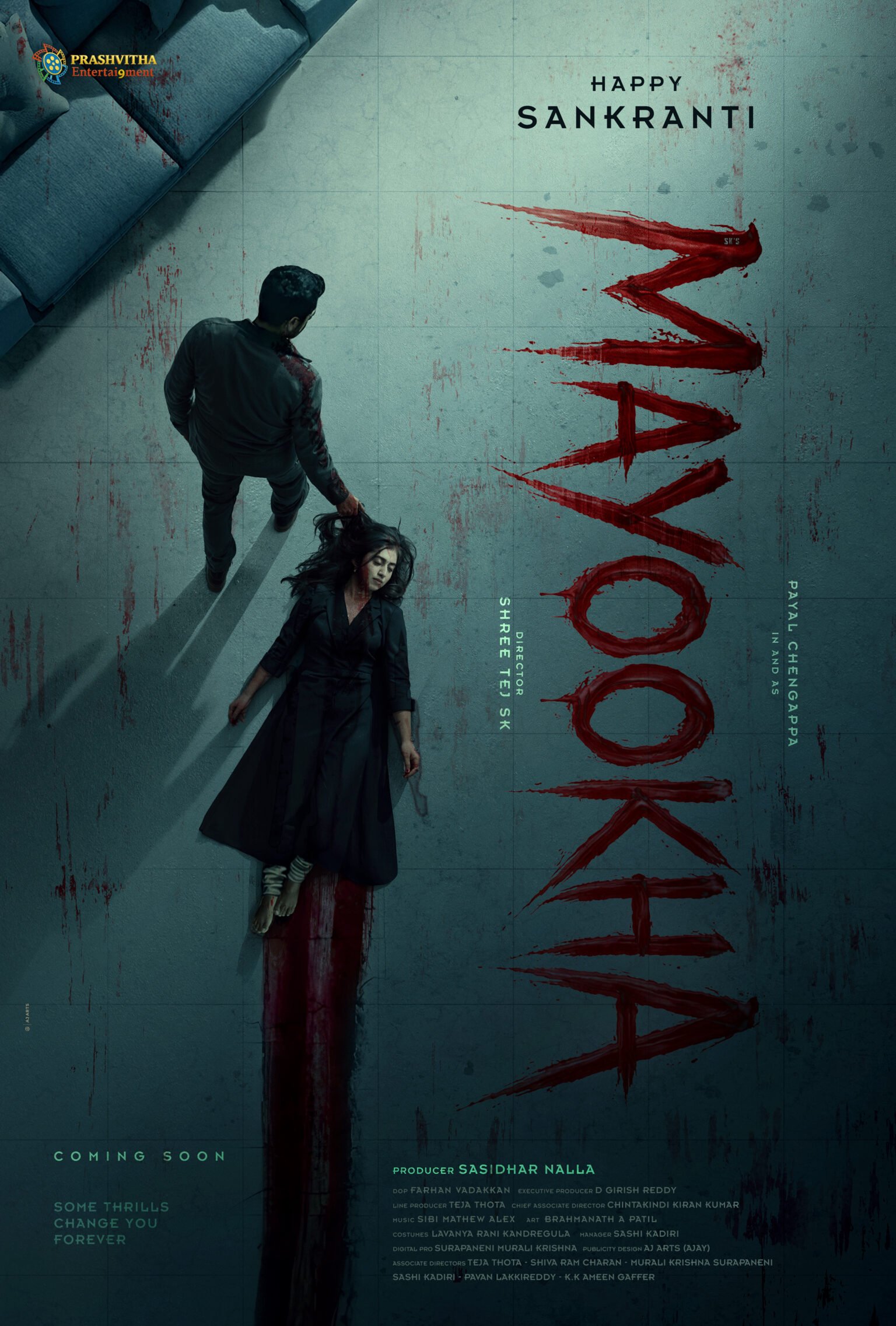

Unveiled with a striking first-look poster on the festive occasion of Sankranthi, Mayookha instantly sets itself apart as a chilling, atmospheric thriller that dares to explore a deeply unsettling fear: what if someone is living in your house without your knowledge—and you are their next victim?
Directed by Shree Tej SK, also known as Srikanth Kandragula, Mayookha promises a nerve-racking cinematic experience rooted in paranoia, silence, and psychological dread. The core idea of the film taps into an everyday sense of safety—the home—and slowly dismantles it, turning familiarity into fear.
Speaking about the film, the director has openly acknowledged that the story draws inspiration from multiple Hollywood, Korean, and Spanish thrillers, particularly those known for minimalism, tension-driven narratives, and psychological realism. Rather than imitation, Mayookha appears to synthesize these global influences into a story grounded in an Indian setting but told with a distinctly international sensibility. This intention is clearly reflected in the film’s tone and narration, which already feel “foreign” and unconventional—something the first-look poster strongly conveys through its stark composition, overhead framing, and restrained color palette.
Leading the film is Payal Chengappa, whose role appears central to the emotional and psychological weight of the narrative. The poster imagery hints at vulnerability, danger, and a tragic stillness, suggesting a performance that goes beyond surface-level fear and delves into the cost of being unknowingly hunted.
The film is produced by Sasidar Nalla under the banner of Prashvitha Entertai9ments, with Girish Reddy serving as the executive producer. Together, the team seems focused on delivering a content-driven thriller with strong technical finesse and theatrical appeal.
Adding further depth to the storytelling is Chintakindi Kiran Kumar, who has contributed to the additional story elements and dialogues, helping shape the film’s layered narrative and psychological complexity. The film’s visual world is crafted by art director Brahmanath A Patil, whose work appears crucial in creating the cold, oppressive spaces that mirror the characters’ inner fears.
In a conscious move to enhance the film’s international texture, Mayookha brings in key technical talent from Kerala. Cinematography is handled by Farhan Vadakkan, whose visual style is expected to emphasize mood, shadows, and claustrophobia. Music is composed by Sibi Matthew Alex, aiming for a background score that heightens tension rather than overpowering it. Costumes are designed by Lavanya Rani Kandregula, contributing subtle realism that keeps the film grounded even as it explores extreme psychological states.
Releasing the first look during Sankranthi—a time usually reserved for celebratory, family-oriented cinema—signals the makers’ confidence in Mayookha as counter-programming: a dark, intelligent thriller meant for audiences seeking something bold and different.
With its haunting premise, global inspirations, and a technically strong team, Mayookha positions itself as more than just a thriller. It is a story about unseen danger, violated personal space, and the terrifying idea that evil doesn’t always break in—sometimes, it quietly moves in and waits.
As anticipation builds, Mayookha stands poised to become a gripping addition to the new wave of Indian psychological thrillers that dare to think—and feel—beyond convention.
With its haunting concept, global influences, and a strong creative team, Mayookha positions itself as a psychological thriller that doesn’t rely on noise, but on fear that quietly creeps in and refuses to leave. As it heads toward its summer release, Mayookha stands poised to offer audiences a chilling, edge-of-the-seat cinematic experience.