


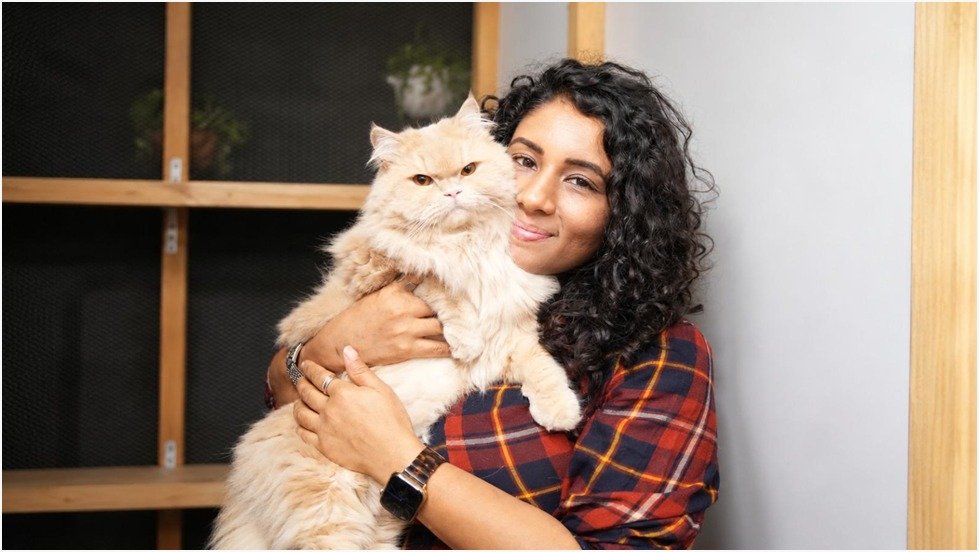
As more Indian households welcome cats into their families, Isha, popularly known as The Cat Lady, highlights why responsible cat parenting requires more than affection, expensive accessories, and a bowl of food.
For years, dogs have dominated conversations around pet parenting in India. But quietly, another companion has been finding its way into Indian homes, apartments, and hearts: the cat.
According to Euromonitor International estimates reported by Agriculture and Agri-Food Canada, India’s pet cat population grew from approximately 2.4 million in 2020 to 4.5 million in 2025. It is a significant shift, reflecting the increasing place of cats in Indian households.
But behind this growth lies a question that deserves more attention: Are we becoming better cat parents, or are we simply becoming more cat owners?
For Isha, a devoted parent to five cats and the person behind a professional cat boarding business, this distinction is especially important. Her experience caring for cats with different personalities, routines, and temperaments has shaped her belief that loving a cat and understanding a cat are not always the same thing.
The Biggest Misconception: Cats Are Easy Pets
One reason cats appeal to urban households is their reputation for being independent and low-maintenance.
They do not need daily walks like dogs. They groom themselves. They can spend hours sleeping and may appear perfectly content doing their own thing.
But independence should never be confused with an absence of needs.
Cats require appropriate nutrition, clean litter boxes, regular veterinary care, physical activity, mental stimulation, and a safe environment. Just as importantly, they need opportunities to express natural behaviours such as scratching, climbing, hiding, exploring, and playing.
A cat that sleeps throughout the day is not necessarily bored, just as a cat that avoids attention is not necessarily unfriendly. Understanding the difference requires observation rather than assumptions.
Your Cat Is Communicating. Are You Listening?
Unlike humans, cats cannot explain when they feel overwhelmed, uncomfortable, frightened, or stressed. Their communication is often subtle, and it is easy to misinterpret.
A cat hiding when guests arrive may be seeking safety rather than behaving antisocially. A sudden change in litter-box habits may signal a health problem, stress, or an unsuitable toileting environment rather than disobedience.
Even the affectionate cat that suddenly bites during petting may simply have reached its tolerance for physical interaction.
The mistake is expecting cats to communicate affection and discomfort exactly as humans or dogs do.
In Isha’s approach to cat care, respecting each cat’s personality is fundamental. Some cats actively seek human companionship, while others prefer quiet proximity. Some adjust quickly to unfamiliar surroundings, while others need considerably more time and reassurance.
Responsible cat parenting begins when we stop expecting every cat to behave the same way.
An Instagram-Worthy Home Isn’t Necessarily a Cat-Friendly Home
Modern pet parenting often involves beautiful beds, elaborate toys, stylish feeding stations, and an endless collection of accessories.
But a genuinely cat-friendly environment is not determined by how attractive it looks.
Cats benefit from accessible hiding places, elevated resting areas, scratching surfaces, clean and appropriately located litter boxes, and separate spaces for food and water.
For households with multiple cats, these needs become even more important. Sharing a home does not automatically mean sharing the same social preferences.
Two cats may live together peacefully while still needing individual spaces and uninterrupted access to essential resources.
The real measure of a cat-friendly home is not how much money has been spent on it. It is whether the cat feels safe, comfortable, and able to make choices.
The Emotional Side of Cat Parenting We Often Overlook
There is another aspect of cat ownership that deserves greater attention: the importance of familiarity and routine.
Cats can form meaningful bonds with their caregivers and become accustomed to the predictable rhythms of their homes.
Changes in surroundings, unfamiliar animals, loud noises, travel, or disruptions to routine can be stressful for some cats.
This is particularly relevant when families travel and need temporary care arrangements.
For Isha, whose work involves caring for cats beyond her own five, the responsibility goes beyond simply providing food and shelter. The broader principle is to understand the individual cat’s routine, temperament, and comfort needs.
Whether a cat stays at home with a trusted sitter or visits a boarding facility, the decision should consider its health, stress tolerance, safety, and familiarity with the environment.
Because good cat care is not about treating every cat identically. It is about recognising what each cat needs.
India’s Cat Parenting Culture Needs to Evolve
The growing popularity of cats is an encouraging development for animal companionship in India. However, responsible ownership requires a corresponding growth in awareness.
Prospective cat parents need to understand that bringing a cat home can mean a commitment lasting well over a decade.
They must be prepared for preventive veterinary care, vaccinations, parasite prevention, sterilisation discussions with their veterinarian, suitable nutrition, and daily enrichment.
They also need to move beyond long-standing misconceptions: that cats are selfish, incapable of affection, impossible to train, or somehow less emotionally connected to their families than dogs.
Cats are neither miniature dogs nor decorative companions. They are animals with their own behavioural and welfare needs.
A better future for cat parenting will depend not only on the number of people choosing cats, but on how seriously those people take the responsibility of caring for them.
From Cat Lovers to Cat-Informed Families
India’s relationship with cats is changing, and that change presents an opportunity.
An opportunity to normalise responsible adoption, encourage feline-specific veterinary care, build safer homes, and educate families about cat behaviour.
Through her experiences as a cat parent and boarding professional, Isha represents a growing conversation around more informed, compassionate feline care.
Ultimately, the goal should not be to make cats adapt to every expectation we have of them. It should be to create environments and relationships in which they can thrive as cats.
Because the true sign of a nation that loves cats is not how many homes have one. It is how well we understand the cats living in those homes.
About Isha – The Cat Lady
Isha is a cat parent to five cats and runs a professional cat boarding business. Through her hands-on experience caring for cats with different personalities and needs, she advocates for responsible cat parenting, greater awareness of feline behaviour, and more compassionate approaches to cat care in India.