


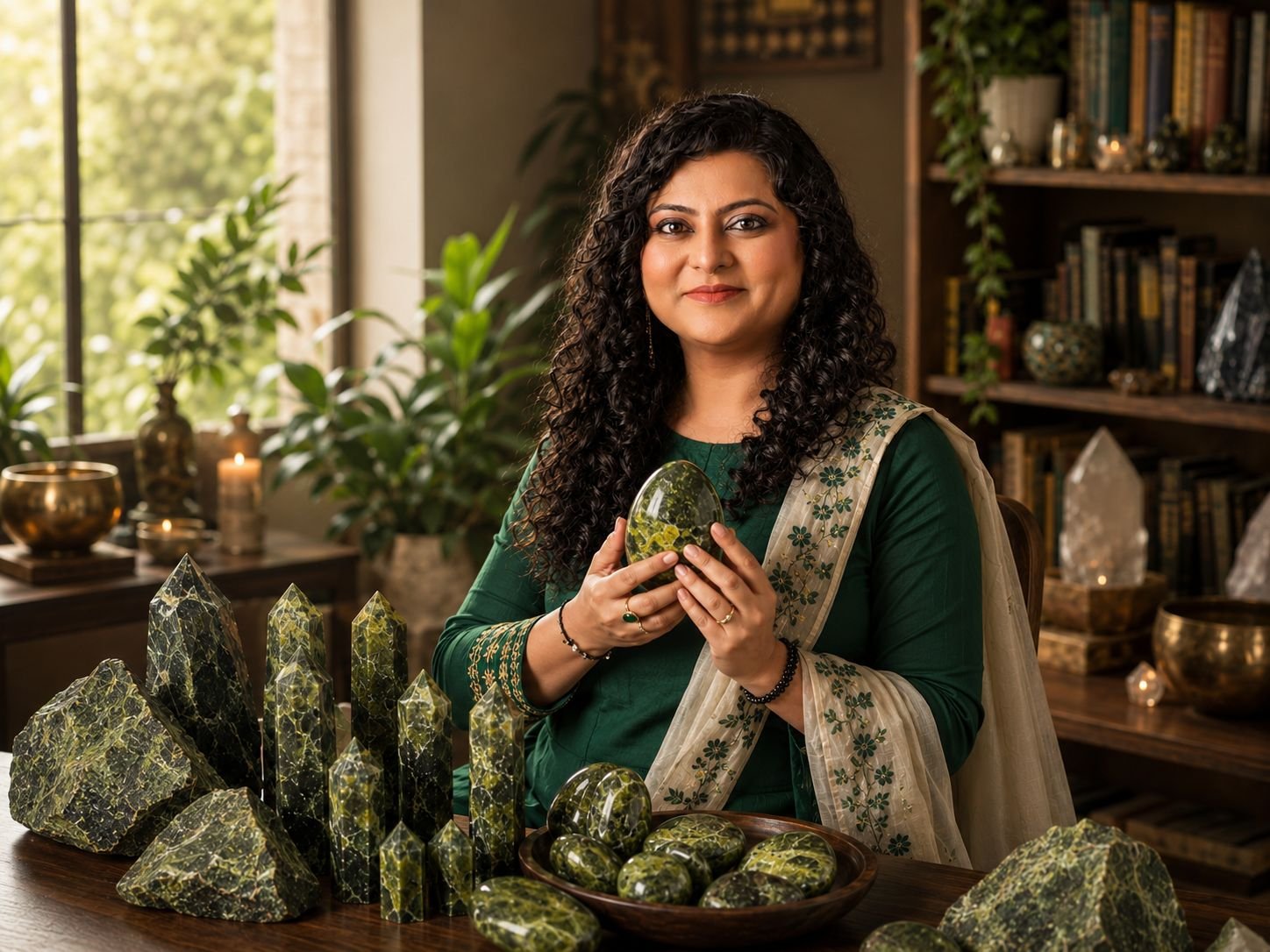
The Quiet Power of Serpentine: Why This Green Crystal Is Having a Moment
Inside the ancient stone that’s finding a new audience among the mindful, the overwhelmed, and the spiritually curious
There is a particular shade of green, mottled and moss-like, that has been quietly working its way into meditation corners, office desks, and crystal collections around the world. It belongs to Serpentine, a stone whose name comes from the Latin serpens, meaning serpent, a nod to its scaly, textured surface that often resembles the skin of a snake.
For centuries, this unassuming crystal was overshadowed by flashier stones. Today, it is becoming one of the most talked-about additions to the wellness world. To understand why, it helps to start with what Serpentine actually is.
What Is Serpentine Crystal?
Serpentine is not a single mineral but a family of related minerals, formed deep within the earth through the transformation of magnesium-rich rocks over millions of years. This geological process gives Serpentine its signature look: swirling bands of green, sometimes shot through with black, yellow, or white veining, giving each piece a slightly different personality.
Its appearance has long invited comparison to reptilian skin, which is partly how it earned its name and its mystique. In ancient cultures, snakes were often symbols of transformation and renewal, and Serpentine inherited some of that symbolic weight.
Historically, the stone has appeared in architecture, jewelry, and carved artifacts across civilizations, from the Mediterranean to Central Asia. Its durability and striking color made it a favorite for both practical objects and ceremonial pieces. In many traditional healing systems, it was regarded as a grounding stone, one connected to the earth’s steady, unhurried rhythm.
What has fascinated people for generations is not just its look, but what it seems to represent: patience, resilience, and quiet transformation, qualities that feel especially relevant today.
Why Is Serpentine Becoming Popular Today?
Walk into any wellness studio or scroll through any mindfulness-focused corner of the internet, and you will notice a shift. People are moving away from noise and toward stillness. They are trading overstimulation for grounding rituals, whether that means slow mornings, breathwork, or simply holding something tangible while they think.
This is, in many ways, why Serpentine has resurfaced. In a culture defined by constant notifications and endless scrolling, there is something appealing about a stone associated with slowing down.
Crystal healing more broadly has seen a steady revival, driven largely by younger generations seeking meaning outside of traditional structures. Serpentine, with its understated green tones and earthy symbolism, fits naturally into this movement. It is not flashy. It does not promise overnight transformation. It simply invites reflection, and for many people navigating an overwhelming world, that invitation feels timely.
Traditional Uses of Serpentine Crystal
Within crystal healing traditions, Serpentine holds a specific place. It is important to note that these are long-held spiritual beliefs and wellness practices, not scientific claims.
Practitioners have traditionally used Serpentine during meditation, often holding it or placing it nearby to encourage a sense of calm focus. It is also associated with emotional grounding, believed to help anchor scattered thoughts during moments of stress.
In energy work, some traditions link Serpentine to the heart chakra, associating it with themes of balance and renewal. It has also found a home in home décor, where collectors and design-conscious homeowners place it in spaces meant for rest or reflection.
Many people incorporate Serpentine into intention-setting rituals, using the stone as a physical reminder of a personal goal or mindset they are cultivating. Others simply keep it as part of a growing crystal collection, drawn to its texture and color as much as its symbolism.
Siddhi reveals that in her own practice, Serpentine is often one of the first stones she introduces to beginners, precisely because it does not demand belief or ritual expertise. She notes that its traditional role as a grounding companion makes it approachable, a stone people can simply sit with rather than actively “work” with.
Potential Benefits People Associate with Serpentine
It is worth being clear from the outset: these are benefits people commonly associate with Serpentine through belief and tradition, not medical or scientific claims.
Many describe a sense of emotional balance when working with the stone, a feeling of steadiness that helps them navigate difficult moments. Others associate it with inner peace, using it as a companion during quiet reflection or journaling.
Some crystal practitioners connect Serpentine to confidence and mental clarity, believing the stone supports a clearer, more centered state of mind. Grounding is one of the most frequently mentioned associations, the sense of being rooted rather than swept up in daily chaos.
There is also a belief among some practitioners that Serpentine can assist in releasing old emotional patterns, offering a symbolic nudge toward letting go of what no longer serves a person’s growth. Others simply feel more connected to nature when holding the stone, appreciating its raw, earthy origin.
For those who meditate regularly, Serpentine is often described as a supportive presence, something that helps maintain focus without forcing it. And for many, it becomes part of a larger personal transformation, a small object that accompanies bigger internal shifts.
Siddhi reveals that one of the most common things clients tell her about Serpentine is a feeling of “settling,” a subtle shift from mental noise to quiet steadiness within the first few sessions of working with the stone. She is careful to frame this as a personal, subjective experience rather than a guaranteed outcome, but says it is one of the most consistently reported associations she hears.
What Problems Do People Hope Serpentine Helps With?
People rarely pick up a crystal at random. Usually, there is a reason, a feeling they are trying to address or a shift they are hoping to encourage.
For many newcomers to crystal healing, that reason is feeling mentally overwhelmed. Between work demands, family responsibilities, and constant digital noise, it is not surprising that so many are drawn to a stone associated with grounding.
Stress is another common motivator, along with a sense of emotional heaviness that can be hard to name but easy to feel. Some come to Serpentine hoping to build confidence, particularly during periods of transition or self-doubt.
Others describe feeling disconnected, whether from themselves, from nature, or from a sense of purpose, and are drawn to the stone’s traditional association with reconnection. Difficulty focusing is a frequent concern as well, especially among people navigating demanding schedules.
Beyond the everyday, many are simply seeking spiritual growth, wanting a practice that feels personal and intentional rather than prescribed. And for some, the goal is emotional resilience, the ability to move through challenges with a bit more steadiness. These are personal beliefs and wellness motivations, shaped by individual experience rather than universal guarantees.
How to Use Serpentine Crystal
For those curious about incorporating Serpentine into daily life, the practices tend to be simple and flexible.
Many people choose to carry a small piece in their pocket or bag, treating it as a quiet companion throughout the day. Others prefer to hold it during meditation, allowing its texture and weight to anchor their attention.
Placing Serpentine on a desk is a popular choice for those seeking a grounding presence during work hours. It also finds a place in home energy spaces, often positioned near meditation cushions, altars, or reading nooks.
Some practitioners incorporate Serpentine into crystal grids, arranging it alongside other stones to create a layered intention-setting practice. Others use it as a journaling companion, keeping it nearby while writing through emotions or goals.
A simple mindful breathing exercise, holding the stone while taking slow, deliberate breaths, is one of the more accessible ways beginners engage with Serpentine, requiring no prior experience or ritual knowledge.
Siddhi reveals that she often recommends keeping Serpentine within arm’s reach during moments of overwhelm, rather than reserving it only for formal meditation. In her experience, the stone’s traditional association with grounding tends to feel most useful in the ordinary, in-between moments of the day, not just the quiet, dedicated ones.
Caring for Your Serpentine Crystal
Like most natural stones, Serpentine benefits from gentle, consistent care.
Cleaning is best done with a soft, damp cloth rather than harsh chemicals, which can affect the stone’s surface over time. Many practitioners also cleanse their crystals energetically, using methods such as moonlight exposure or sound, based on personal or traditional practice.
For storage, a soft pouch or lined box helps protect Serpentine from scratches, particularly if it is kept alongside other crystals. Because Serpentine contains magnesium and can be sensitive to prolonged water exposure, it is generally recommended to avoid soaking it for extended periods.
Handling the stone with a sense of respect, rather than carelessness, is a value shared across many crystal traditions, reflecting the broader intention behind crystal healing itself: mindfulness, not just possession.
Expert Insight
According to Siddhi Shah, founder of Yana’s Healing Studio, many people are increasingly drawn to crystals not because they expect instant miracles, but because these ancient stones often serve as meaningful reminders to slow down, reconnect with themselves, and cultivate mindful intentions.
Shah, who works as a spiritual mentor, crystal educator, divination expert, and holistic wellness guide, has observed this shift firsthand among students and clients navigating the pressures of modern life.
Her perspective reflects a broader truth about crystal healing as a whole: it is less about the stone itself and more about the intention, attention, and ritual a person brings to it. Serpentine, in this sense, becomes less an object of magic and more a tool for mindfulness, a small, tangible anchor in an often chaotic world.
A Stone for Slowing Down
Serpentine’s growing popularity says less about trends and more about timing. In a world that rarely pauses, a stone rooted in patience and grounding feels almost countercultural.
Whether approached as a meditation companion, a decorative piece, or simply a curious addition to a growing collection, Serpentine offers something increasingly rare: an invitation to slow down and listen inward.
Crystals like Serpentine will not solve life’s challenges on their own. But as reminders, as rituals, as small daily touchpoints of intention, they offer something meaningful nonetheless. For those willing to approach it with curiosity rather than expectation, Serpentine may simply be the quiet nudge toward mindfulness that modern life so often makes difficult to find on our own.