
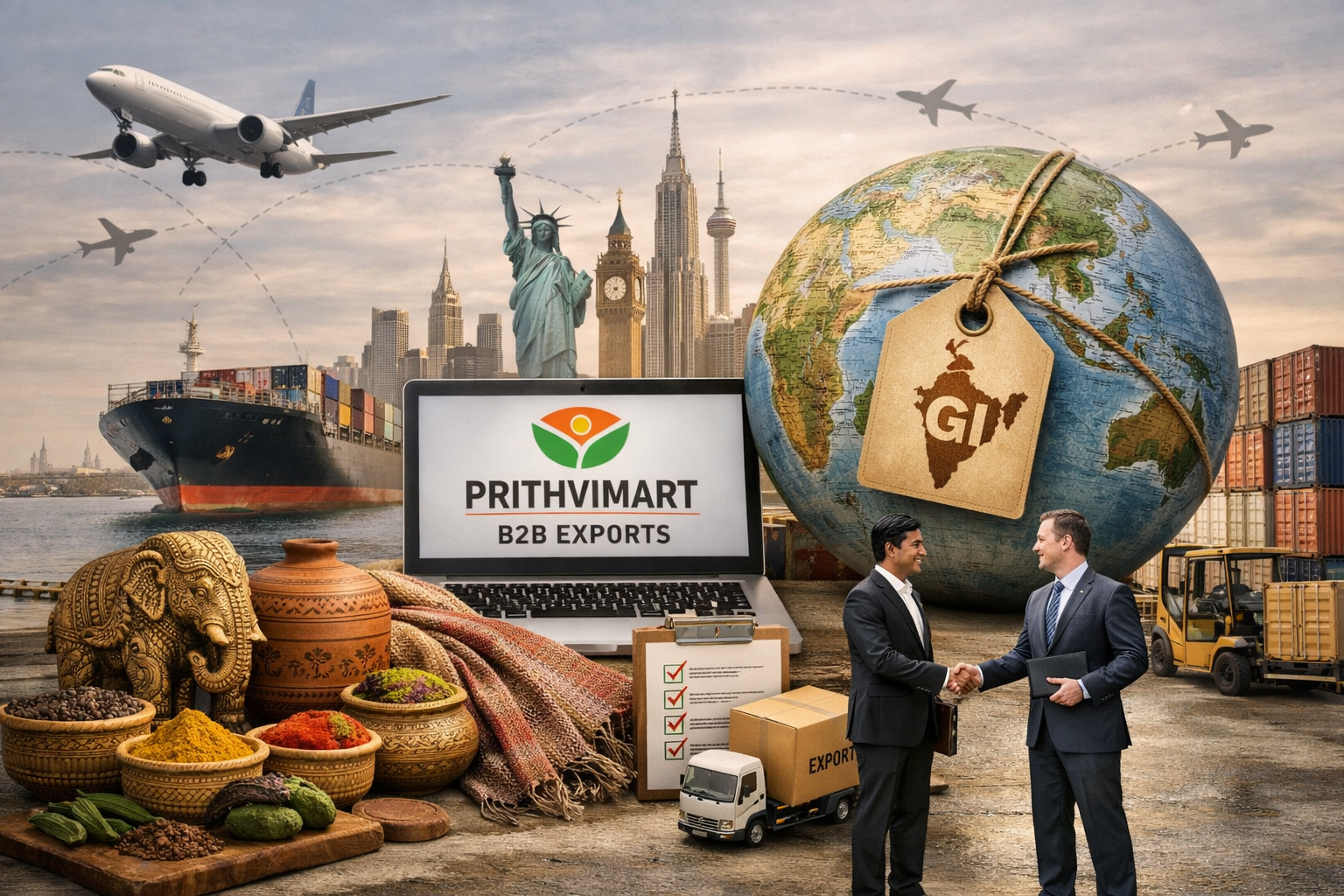
The marketplace’s new B2B service is designed to help Indian brands, manufacturers, artisans and GI-tag producers connect with overseas buyers while navigating visibility, trust and export complexity.
By Kartik Sharma
Editor’s Note:
This is a guest opinion article by Kartik Sharma, Co-founder and CEO of PrithviMart. The views expressed are personal and focus on the market-access challenges facing Indian MSMEs, exporters, and GI-linked producers in global trade.
Guest Op-Ed
India does not have a shortage of products with export potential. What it often lacks is a reliable and structured way for smaller businesses to reach global buyers.
Across India, manufacturers, artisans, regional producers and emerging brands are creating goods that can compete well beyond domestic borders. From food and wellness to heritage products, handicrafts and region-specific specialties, the supply is there. Global interest is there too. But between Indian producers and international demand lies a familiar set of barriers: limited buyer discovery, fragmented export access, operational complexity, and insufficient trust at the point of commercial engagement.
This is the gap that, in my view, Indian trade infrastructure must now address more aggressively.
For years, much of the export conversation has centred on scale, manufacturing strength and cost competitiveness. Those remain important. But global trade is also evolving in another direction. Increasingly, buyers are looking for products with authenticity, provenance, quality assurance and cultural distinctiveness. They want dependable sourcing relationships, not just transactional supply. That creates a significant opening for Indian businesses, especially MSMEs and regional producers, whose strength often lies in product identity and authenticity rather than just scale.
Yet many of these businesses remain underrepresented in international markets.
The reason is not always weak demand. In many cases, it is weak access. A small or mid-sized Indian business may have a strong product, but still struggle to identify the right overseas buyer. It may not know how to present itself to importers, distributors or retailers in a way that inspires confidence. It may be capable of fulfilling international demand, but not yet equipped to navigate the practical demands of export logistics, buyer expectations and structured market entry.
That is why I believe B2B trade platforms now have a much bigger role to play than simply listing products online.
The real value of a modern B2B export-facing platform lies in reducing fragmentation. It should help businesses become easier to discover, easier to understand and easier to trust. It should make it simpler for global buyers to identify suppliers that are credible, prepared and aligned with their sourcing needs. And it should help Indian sellers move from being export-capable in theory to export-visible in practice.
This is the thinking behind PrithviMart’s B2B push.
Our effort is built around a simple idea: Indian businesses need better bridges to international markets. Many businesses should not have to rely only on trade fairs, sporadic referrals or scattered intermediaries to be found by buyers abroad. They need a more structured digital route to connect with serious demand across the United States, Canada, the United Kingdom, Europe, the UAE, Singapore, Australia and other global markets.
That need is especially acute for MSMEs. These businesses are central to India’s economic base, but they often face an uneven playing field in cross-border trade. Larger firms tend to have established networks, export teams and deeper operational resources. Smaller producers, even when they make high-quality goods, often struggle to gain visibility in front of the right international audience. In such cases, the challenge is not product quality. It is market access.
The same is true, perhaps even more strongly, for India’s GI-tag products.
GI goods represent some of the most distinctive and culturally valuable offerings in the country’s product landscape. They are deeply tied to geography, traditional skill, local economies and regional identity. In an era when global buyers increasingly care about provenance and authenticity, these products should be among India’s strongest commercial ambassadors. And yet many of them remain underrepresented internationally.
That underrepresentation is not only a trade issue. It is also a missed opportunity for regional economic visibility.
A GI-tag product may carry heritage and trust in its place of origin, but that does not automatically convert into international commercial relevance. For that to happen, there needs to be structured buyer access, clearer presentation, stronger authenticity signalling and a business environment that helps such products be seen as globally sourceable rather than merely locally admired.
This is why stronger B2B access for GI-tag and heritage products matters. It can help global buyers discover Indian products that are not generic or interchangeable, but differentiated by origin, tradition and identity. It can also help producers move beyond isolated recognition toward real commercial participation in international markets.
At the heart of all of this is one principle: trust.
In cross-border trade, visibility matters, but trust matters more. Buyers do not only want product range. They want reliability, transparency and confidence that the supplier they are engaging with is genuine and capable. Sellers, on the other hand, need platforms and systems that do more than increase impressions; they need mechanisms that help establish credibility.
If India is serious about expanding the global competitiveness of its MSMEs, exporters and specialty product businesses, then improving this trust-and-access layer will be essential. Market-access infrastructure is no longer a secondary issue. It is now central to trade growth.
PrithviMart’s B2B service is our attempt to contribute to that shift. But the broader point goes beyond any one platform. India’s next phase of export growth will depend not only on what it produces, but also on how effectively its businesses are connected to global demand.
India already has the products, the stories, the craftsmanship and the production capabilities. What many businesses still need is a better route to the world.
Author Bio:
Kartik Sharma is Co-founder and CEO of PrithviMart, a cross-border marketplace focused on helping Indian products reach international consumers and buyers. He writes on trade access, export growth, global market entry, and the role of digital platforms in expanding opportunities for Indian businesses.