


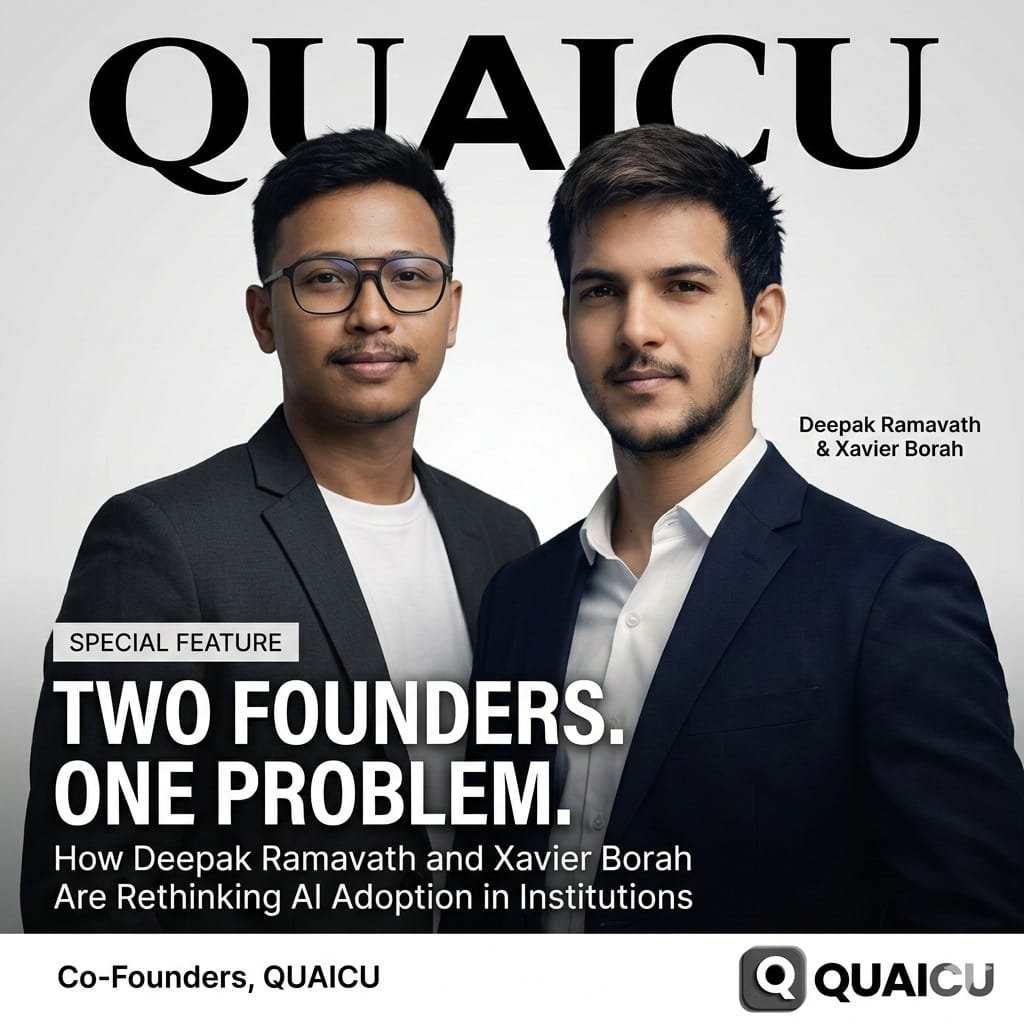
The two founders believe the future of enterprise AI will be defined not by better models alone, but by the infrastructure that allows institutions to deploy them effectively.
Artificial intelligence is advancing faster than most organizations can adapt.
Every few months, new models promise improved automation, smarter decision-making, and the potential to transform entire industries. From universities experimenting with AI-driven administration to financial institutions exploring automated workflows, the technology is being introduced across nearly every sector.
Yet inside many institutions, the reality of AI adoption looks very different from the promise.
Tools are deployed. Pilot programs are launched. Vendors demonstrate impressive capabilities. But months later, many organizations find themselves asking the same question:
Why hasn’t anything actually changed?
For Deepak Ramavath and Xavier Borah, this question became the starting point for building QUAICU, a company focused on developing infrastructure designed specifically for institutional AI.
Two Different Perspectives On The Same Problem
The two founders arrived at the problem from very different professional experiences.
Ramavath’s background exposed him to the operational complexity inside institutions. Working within financial services and academic environments, he observed how organizational workflows were shaped by layers of administrative processes and disconnected systems.
Many institutions relied on a patchwork of digital tools each designed to solve a specific problem but rarely integrated into a cohesive operational system.
Employees often became the bridge connecting these tools, manually transferring data between systems and coordinating workflows across departments.
Ramavath began describing this phenomenon as operational fatigue.
Highly trained professionals were spending a significant portion of their time navigating systems rather than focusing on the work they were hired to perform.
The Infrastructure Gap Behind Enterprise AI
Meanwhile, Borah was encountering a different but closely related issue.
Working with organizations deploying modern data platforms and AI solutions, he observed that many institutions lacked the infrastructure required to operationalize the technologies they were purchasing.
In many cases, organizations had already invested in advanced AI tools. But the underlying data environments remained fragmented across legacy databases, spreadsheets, and internal applications.
This created what Borah describes as an execution gap.
AI tools that appeared powerful during demonstrations often struggled to deliver measurable impact once deployed inside real institutional workflows.
“Most of the clients I worked with had AI tools that technically worked,” Borah says. “But those tools were not translating into operational efficiency.”
A Shared Realization
At first, the two founders discussed the issue informally.
They had known each other since college, and their conversations often returned to the same observation: institutions were adopting technology designed for environments that looked nothing like their own.
Technology companies frequently build products with a rapid innovation mindset prioritizing speed, iteration, and experimentation.
Institutions, particularly those operating in regulated sectors such as education, healthcare, and finance, operate under very different conditions.
Their systems are shaped by governance requirements, compliance frameworks, and organizational structures that evolve slowly over time.
The mismatch between these two worlds can create significant friction.
“Tech companies operate with a ‘move fast and break things’ mentality,” Borah explains. “But for institutions, breaking things is not an option.”
Building Infrastructure Instead Of Another Tool
This realization led the founders to rethink what institutions might actually need in order to adopt artificial intelligence effectively.
Rather than building another AI application, they began exploring the idea of building an operational layer capable of orchestrating the many tools institutions already use.
The result was QUAICU, which the founders describe as an institutional AI operating system.
Instead of replacing existing software entirely, the system is designed to integrate and coordinate fragmented tools across departments.
The ALIS OS Approach
In universities and colleges, this approach is implemented through ALIS OS, QUAICU’s platform designed to unify workflows across departments such as admissions, academics, administration, and finance.
The platform can connect with existing tools used by institutions, allowing organizations to modernize operations without discarding systems that may still serve specific functions.
The goal is not simply to automate tasks, but to reduce the operational overhead created by fragmented systems.
Measuring Institutional Readiness For AI
To guide deployments, the founders also developed the Institutional AI Maturity Index, a framework designed to help organizations assess their readiness for AI adoption.
Rather than encouraging institutions to adopt AI because it is trending, the framework focuses on diagnosing infrastructure readiness first.
Infrastructure Before Intelligence
This approach reflects a broader shift that both founders believe is emerging across the technology landscape.
While early conversations around artificial intelligence focused primarily on model capabilities, attention is increasingly turning toward the systems that enable those models to function reliably.
For institutions operating in regulated environments, those systems must also support governance, transparency, and data sovereignty.
As AI continues to evolve, Ramavath and Borah believe the organizations that succeed with intelligent technologies will not necessarily be those that adopt them fastest.
Instead, success may depend on which institutions build the infrastructure required to use them responsibly.
“The real transformation isn’t just AI,” Ramavath says.
“It’s the systems that allow institutions to actually use AI.”