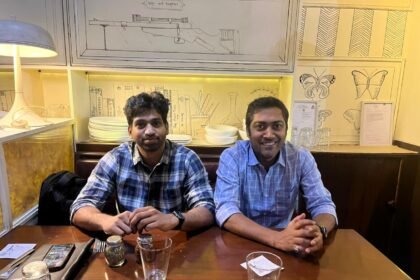



In a quiet corner of Pilani—a town better known for academic institutions than disruption—21-year-old Shivam Mishra is working on something far removed from the usual college trajectory.
He’s building systems designed to replace the need for human-operated workflows entirely.
Not assist them. Replace them.
And unlike most narratives that begin with early genius or clear direction, Shivam’s didn’t start that way at all.
The Accidental Starting Point
When Shivam first entered college, there was no plan.
No clarity. No defined ambition. Just confusion.
Like most students at that stage, he didn’t know what to pursue or where to focus. There was no master vision, no startup idea, no roadmap.
So he started with something simple.
Typing.
Not coding. Not building products. Not AI.
Just learning how to type faster.
It seems insignificant—but it wasn’t.
That single act created momentum. Sitting in front of a screen, building consistency, getting comfortable with execution—something began to shift.
One small skill turned into curiosity.
Curiosity turned into exploration.
Exploration turned into obsession.
And over time, that same screen became the place where everything else started happening—coding, building, failing, rebuilding.
“It all started with learning how to type,” Shivam says. “After that, things just started falling into place.”
The Isolation That Built Him
Shivam grew up in Jhunjhunu, in what he describes as a normal environment.
But what separated him early wasn’t opportunity.
It was distance from it all.
He didn’t socialize much. Didn’t move in large circles. Didn’t chase the same experiences as his peers.
Instead, he stayed on the outside—observing, thinking, and slowly building a mindset that rejected conformity altogether.
“I never wanted to fit in.”
That wasn’t a reaction.
It was a decision.
The Phase No One Saw
As his curiosity evolved into action, Shivam entered a phase that most people around him never witnessed.
Late-night coding streaks.
Unfinished products.
Failed experiments.
Relentless iteration.
There was no audience. No validation. No recognition.
Only work.
During some of his most intense periods, he lost all sense of time—working for hours, neglecting sleep, barely eating at times, and pushing through financial constraints that made stability uncertain.
What looked quiet from the outside was, in reality, constant internal pressure.
Eventually, that pressure broke.
A combination of burnout, repeated failure, and isolation pulled him into a phase he had to fight his way out of.
There was no external rescue.
Only a reset.
Through discipline—starting with the gym and rebuilding control—Shivam gradually pulled himself back. And one day, without announcement or noise, he made a decision.
He went back to work.
Valenza Media: Engineering the End of Agencies
Shivam is the founder of Valenza Media, a digital marketing company working with medspas and aesthetic clinics across the United States.
On the surface, it operates like a high-performance agency.
But underneath, it’s being built as something far more deliberate.
Valenza Media is being structured into a self-operating growth system, where traditional agency functions—content creation, campaign optimization, client handling—are gradually being replaced by automated workflows and AI-driven processes.
Instead of scaling through hiring, Shivam is scaling through systems.
• Lean execution with minimal human dependency
• AI-assisted content and ad pipelines
• Automated campaign optimization frameworks
• Workflow architectures designed to reduce manual intervention
The goal isn’t to build a bigger agency.
It’s to make the agency model itself irrelevant.
“I’m not building a service business,” Shivam says. “I’m building something that does what service businesses do—without needing people at every step.”
Thinking Beyond Agencies: The Zyrex Direction
If Valenza Media is execution, Shivam’s real focus lies deeper—in infrastructure.
He is working toward Zyrex, a programming language designed for AI-native systems.
The idea is simple—but disruptive.
Instead of writing code that machines follow step-by-step, Zyrex is imagined as a system where each line of code creates intelligent agents capable of handling tasks autonomously.
Not tools.
Not scripts.
Systems that act.
“The future isn’t people managing tools,” Shivam says. “It’s systems managing outcomes.”
If realized, this approach wouldn’t just improve efficiency.
It would redefine how businesses are built, operated, and scaled.
A Different Kind of Discipline
Shivam doesn’t operate on routines.
No fixed schedule. No structured system of productivity.
Only execution.
“I do what needs to be done. However long it takes.”
His focus spans coding, machine learning, automation, and system design—each contributing to a larger ecosystem he is building piece by piece.
It’s not optimized for comfort.
It’s optimized for output.
A Mindset That Divides
Shivam doesn’t try to align with popular thinking.
He is openly critical of what he sees as misplaced priorities—especially among people his age who prioritize relationships or validation before achieving stability.
It’s a stance that won’t resonate with everyone.
But it reflects a mindset built on control, focus, and long-term leverage.
What Comes Next
At 21, Shivam Mishra is still early.
No exits. No public accolades. No inflated claims.
Just systems in progress.
But the trajectory is clear:
• Building AI-driven business infrastructures
• Developing a new programming paradigm
• Positioning himself at the intersection of automation and control
He isn’t chasing attention.
He’s building capability.
The Bottom Line
In a generation driven by noise, Shivam Mishra is building in silence.
What started with something as simple as learning how to type has evolved into something far more ambitious—
A pursuit of systems that don’t just assist humans,
But eventually make them optional.
And if those systems evolve the way he intends them to—
They won’t announce themselves loudly.
They’ll just start working.
Quietly.
And at scale.